

Nabokov and the Cosmic Shell

David Bentley Hart recently republished on Substack an essay he wrote years ago on Vladimir Nabokov. I deeply appreciate Hart’s”baroque” writing, and I am a Nabokov fan from way back.
As I read through the essay, I was struck by this paragraph:
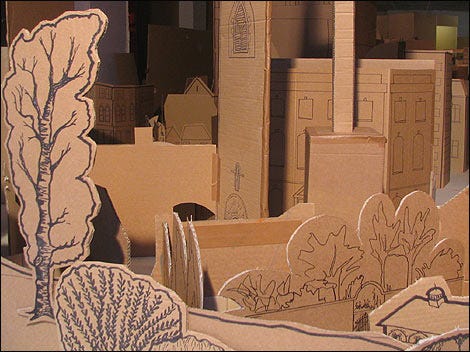
The protagonist of Invitation to a Beheading], Cincinnatus C., is clearly imprisoned in a reality to which he does not properly belong, and which in fact is far less real than he. The world around him is repeatedly revealed to be little more than hastily assembled collections of canvas, pasteboard, painted wood, and plaster, ringed about by crudely daubed theatre scenery, cluttered with poorly constructed props, and populated by secondary characters whose identities are so fluid that they themselves are scarcely more than masks or stage puppets.
This immediately reminded me of an experience I had years ago. I woke up one day, and everything in the room looked two-dimensional. “Canvas, pasteboard, painted wood, and plaster” about fits the bill. I would add “cardboard.” I wondered what was happening. Was I seeing things as they really were? Was I hallucinating? Was I losing some visual capacity?
Somehow, I remembered something in A. H. Almaas’ book, The Point, about the “cosmic shell,” or “universal narcissistic emptiness,” which can lead people to believe that the world is an illusion. This is similar to the way that some Asian spiritual paths speak of material reality…as a dream or maya. (For me, an accurate descriptor would have been “fake.”) When we recognize that what we are seeing is a representation of the world, however, we can see that it is the representation that is empty, not the world itself.
And how does this representation get constructed? It’s an internalized understanding from our history that attaches labels to ourselves and to others based on our experience. So, if I am a kid who excels in math but can’t spell, I construct an internal image of myself as a good numbers person and a bad word person. Like the sign I used to see at the express grocery checkout line: “If you have more than 15 items, are you an English major who can’t count or a math major who can’t read?”
Without understanding the nature of this experience, a person could easily fall into nihilism or despair. For me, it was unsettling, but I stayed curious. What was this? Just as when we squint to see more clearly, I squinted at this fake world around me. What was it made of? Nothing tangible or substantial. Oh, it is my thoughts about the world! My thoughts and my memories are projected onto the world around me. No wonder it felt like cardboard. The alive, pulsating, scintillating reality of the world was hidden behind a flimsy construction of my own thoughts, images, ideas, memories.
So if you wake up one day and the world around you looks like cardboard, you’ll know what’s happening. You haven’t lost your mind, but you’re on the cusp of losing your filters and seeing what’s glistening behind them.