

No-Self? Nobody??
A subtle discrimination

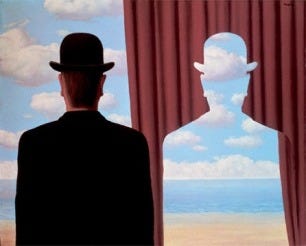
A few years ago, I finally read Bernadette Roberts’ book, The Experience of No-Self. (Read the book for free here.) It’s a fascinating book, not only because of the content but also because of the structure. The first part of the book relates her extended and eventful journey to the far reaches of the Christian path. In the second part, she writes about the reactions others have had when she told them of some of her experiences. I don’t know of any other spiritual book with this structure. (If you don’t know the book and aren’t drawn to reading it, I can highly recommend Samaneri Jayasara’s 16-minute reading of an excerpt from the book. In fact, all of her readings are worthwhile! Sometime I’ll write about an experience I had listening to one of her recordings while doing a self-retreat.)
At the time, I was also participating in a 6-month meditation course sponsored by the Samatha Trust. As a longtime practitioner of samatha (Buddhist concentration or serenity meditation), I wanted to know more about how the Trust offered the practice. Perhaps it was a combination of reading the book, being in that course, and my ongoing work in the Diamond Approach, but I was catapulted into a no-self experience.
The truth of no-self is a central feature of Buddhism, one of the pivotal triumvirate (tilakkhana) of the tradition: suffering, impermanence, and no-self (dukkha, anicca, anatta). There’s a whole dark cave to dive into on the topic of no-self in Buddhism, but we’re not going there. Rather, my point is that I knew of this experience and its importance on the Buddhist path. The irony was that a Christian writer ignited the experience.
So, when no-self arose for me, I knew what it was. And it was delightful! So deliciously free! I recognized it when I looked in the mirror. I saw the reflection of my face, but there was no identity behind it. I may as well have been looking at a stranger. And it was fascinating. I could see that my normal experience was to identify with the face in the mirror, to know all about it…its preferences, its history, its beliefs. But now? Nothing.
This continued for a couple of weeks. During that time, a dear, longtime friend visited me. I wondered, would she notice any difference in me? Nope. It seemed that I was still recognizable to those who knew me. I was the same outwardly. But inwardly? Very different.
Sometime perhaps I’ll share what flipped me out of the no-self experience, but for now, I want to pivot to another experience: nobody.
To most ears, no-self and nobody probably sound pretty much alike. The direct experience, though, is not the same.
Like no-self, the experience of nobody arose unbidden. I simply noticed that there was nobody here behind experience. There was experience…things happening…but there was nobody experiencing them. When I looked in the internal mirror, it was empty.
This experience is much less well-known than no-self. The Diamond Approach understands it and compares it to some experiences in the Zen path. The words they might use are “suchness” or “isness.” Things are simply what they are. There is nothing added. As the Zen folks say, “A mountain is a mountain.” And that is true in this experience, but for me, what is assumed but not articulated in that statement is the most salient feature: the lack of anyone to experience the mountain! And the state is so very simple and stripped-down that even to use the labels “suchness” and “isness” is adding too much. For me, the experience of nobody is even more free than no-self.
I wager that most spiritual paths will affirm that, the farther you go, the simpler everything becomes. How simple can it get? I hope to keep finding ways that simple can be even simpler. It also feels important to say that having teachers to help unpack and discriminate these experiences has been vital to my understanding. I know my own experience very well, but teachers help me refine the understanding.
How about you? How does simple appeal to you? How have you experienced simplicity—and in what areas? Is there a relationship between inner simplicity and outer simplicity? And if a spiritual path suggests that ever-simpler simplicity is possible, is that appealing?